Season by Season
Winter is where an uninsulated door shows its age fastest. Kansas City, KS sits in a cold-severe climate band, and a single-layer steel or wood panel door built with no insulation layer does nothing to slow that cold from reaching the garage. If you keep a freezer or a workbench out there, you feel it. Spring brings the opposite problem: warm, damp air meeting a cold metal door skin, and condensation running down the inside face onto the floor. That cycle, repeated every year since the door went up, is what pits hardware and rusts the bottom panel first. Summer is the easy season for these doors - it's the only time of year an uninsulated panel doesn't cost you anything in comfort or moisture. Fall is when the weatherstrip along the bottom and sides matters most, because a door with no insulation and worn seals lets cold air pour straight along the floor into the house side of an attached garage. None of this is dramatic. It's steady wear, season after season, on hardware and panels that were never built to modern thermal standards in the first place. That's the pattern we see on service calls here, not a one-time failure.
How Local Conditions Play In
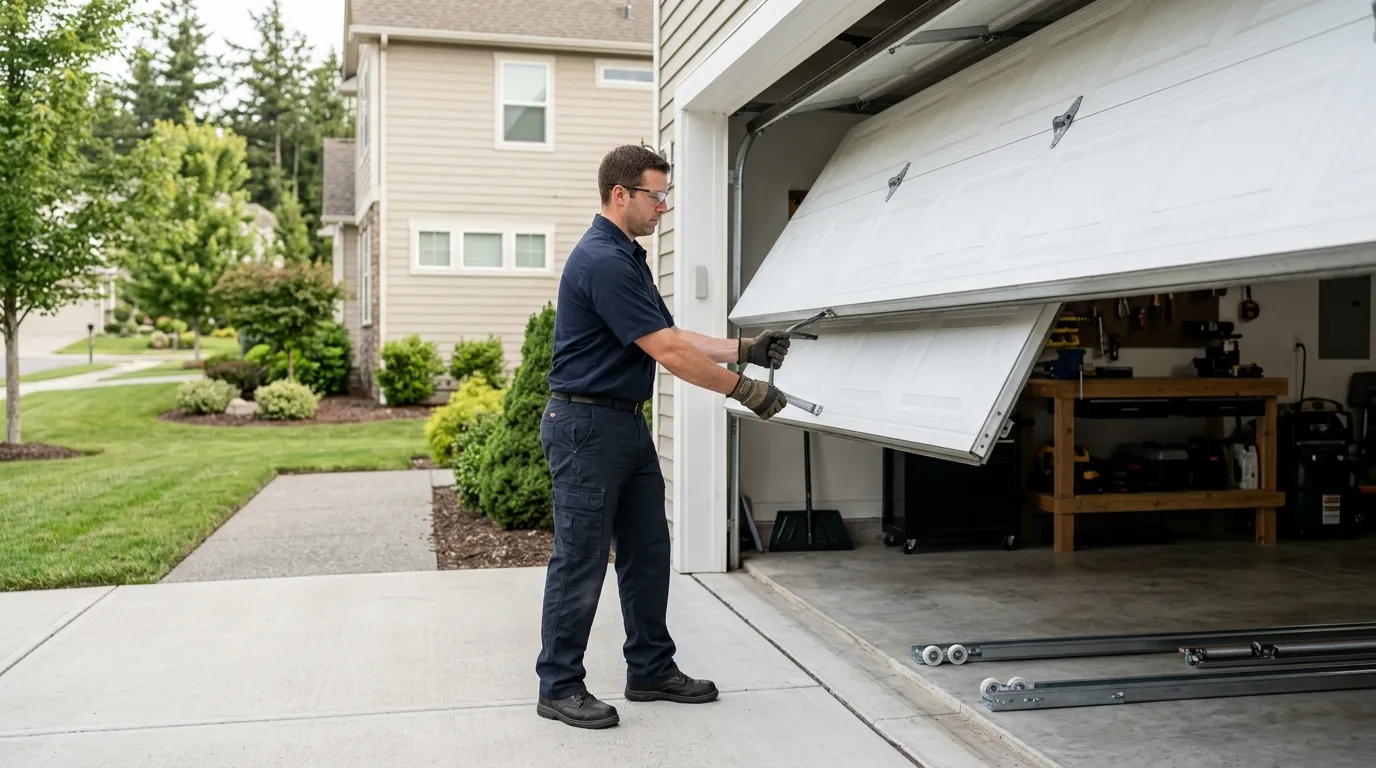
Housing across this service area mostly went up between 1950 and 2004, with the median right around 1973 - well before insulated garage doors were standard or required. In neighborhoods like the bulk of the doors still on the tracks are the same era as the houses: 1960s and 1970s single-skin steel or wood panel units. Nobody swapped them out on any kind of schedule, so a lot of what we open up is original to the build. Pair that housing age with a cold-severe climate band and you get a specific, repeatable problem: doors that were adequate for the era they were built in but were never designed to hold heat or resist condensation. It's not a defect, it's just what a door looked like in 1973. The combination of old stock and hard winters is why insulation retrofit and full replacement come up so often on calls in this part of town, more than in places with newer housing stock or a milder climate. We don't treat every old door the same - a lot depends on whether the panels are still square and the track is still true.
What You Pay
There are 37,757 owner-occupied houses across this service area and 67,367 households total, and a large share of those houses still carry the door they were built with rather than a replacement. Median household income here runs $89,385, which puts full replacement within reach for most owners rather than something that has to be stretched across years of patchwork repair. Whether retrofit or replacement makes more sense for you comes down to the condition of what's already hanging, not a flat rule we can quote before seeing the door. We don't publish a set price list here because the range between an insulation kit on a sound door and a full replacement on a warped one is wide, and quoting either without seeing the door does you no favors. What we can tell you up front is that houses from the 1960s and 1970s stock common in this area, paired with a cold-severe winter, make insulation the first thing worth checking before anything else on the door gets touched.